
Employers often bundle “occupational health” into one diary line and then wonder why the wrong assessment was booked. Absolute Biomedical draws an important distinction on its site: workplace health surveillance UK obligations are not the same as general wellbeing checks or fitness-to-work examinations that are not directly linked to a workplace risk. This article clarifies the three buckets for rail and non-rail employers using Absolute Biomedical’s own framing.
What health surveillance is
Absolute Biomedical describes health surveillance as an ongoing system of health checks, often required by law for employees exposed to noise, vibration, radiation, solvents, fumes, dusts or other hazardous substances.
Purpose, as listed on the site:
- Detects ill-health effects early
- Provides data to evaluate health risks
- Lets employees raise health concerns
- Highlights gaps in workplace controls
- Reinforces training on protective equipment
Absolute Biomedical helps with risk assessments to identify roles that need surveillance. Their copy warns that blanket coverage for all staff is best avoided, as it can mislead and waste money — surveillance should follow risk, not habit.
What fitness-for-work / rail medicals are
A Network Rail Level 1 medical is a fitness-for-work assessment against NR/L2/OHS/00124 so a person can undertake track safety pathways and sponsored rail work. It looks at questionnaire responses, blood pressure, BMI, mobility, hearing, vision/colour vision and general health. It answers: is this person fit for this safety-critical work under the rail standard?
That is related to hearing and vision testing in a broad sense, but it is not automatically the same legal health surveillance programme you might run for hand-arm vibration or noise-exposed workshop staff under COSHH/noise regs.
What corporate health & wellbeing is
Absolute Biomedical’s health and wellbeing services support employers with confidential 1-2-1 appointments, personal medical reports, lifestyle advice, musculoskeletal assessment, hearing and eyesight testing, blood pressure, weight and BMI, and drug & alcohol testing if requested. These programmes help performance and proactive care. They are valuable — and still distinct from mandatory surveillance tied to specific hazard exposure.
Side-by-side comparison
Health surveillance
- Driven by exposure risk and often legal duty
- Ongoing, scheduled by risk profile
- Feeds control measures and H&S risk assessment
- Role-specific, not “everyone in the company”
Fitness-for-work (e.g. rail Level 1)
- Driven by role/competence entry standards
- Validity by age bands for rail medicals
- Outcome used for work authorisation / Sentinel medical status
- May include hearing/vision but for fitness criteria
Wellbeing / corporate health
- Driven by employer benefit and prevention culture
- Flexible content agreed with the employer
- Not a substitute for surveillance where law requires it
- Not a substitute for rail medical standards
Why the distinction saves money and risk
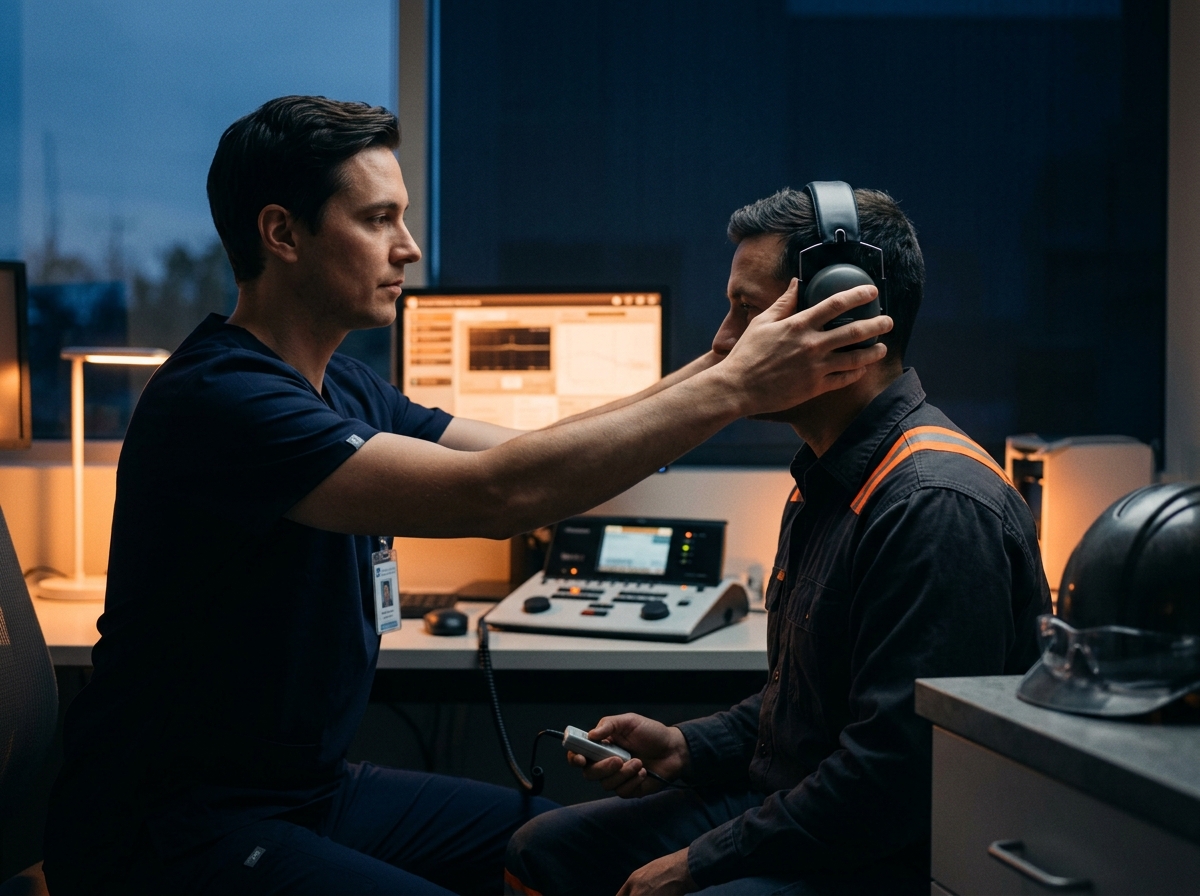
Booking wellbeing “hearing checks” for staff who legally need audiometric health surveillance can leave gaps in your compliance file. Booking surveillance for office staff with no relevant exposure wastes budget — Absolute Biomedical explicitly advises against blanket approaches. Booking a rail medical when you needed surveillance for vibration-exposed plant operators answers the wrong question.
How Absolute Biomedical can support employers
- Risk-assessment support to identify who needs surveillance
- Delivery of surveillance programmes
- Rail medicals and D&A for sponsored workers
- Corporate health & wellbeing programmes
- Centre in Abercynon and discussion of on-site delivery
Contact: 01443 303009 (Mon–Fri 08:30–17:00), [email protected], Ty Cynon, Navigation Park, Abercynon, South Wales CF45 4SN.
Rail employers: you may need all three
A primary sponsor might run:
1. Level 1 medicals + D&A for track staff entry and renewals
2. Health surveillance for workshop or fabrication teams with noise/vibration/chemical exposure
3. Wellbeing days as a retention and performance benefit
Absolute Biomedical’s corporate package language covers medical & D&A screenings, health & wellbeing programmes, and incident response — use scoping calls to map services to risks, not to a single SKU.
Frequently asked questions
Is a rail medical “health surveillance”?
Not in Absolute Biomedical’s important distinction. It is a fitness-to-work examination linked to rail standards, not automatically a hazard-exposure surveillance regime.
Can surveillance results replace a Level 1 medical?
Do not assume interchangeability. Ask Absolute Biomedical and follow Network Rail / sponsor requirements.
Who decides which staff need surveillance?
Start with risk assessment — Absolute Biomedical can support identification of roles that need surveillance.
Next step
For workplace health surveillance UK programme design, or to separate surveillance from rail fitness medicals, call Absolute Biomedical on 01443 303009.
Questions to ask in a scoping call with Absolute Biomedical
- Which roles have exposure that may trigger surveillance?
- Which roles need rail Level 1 medicals and D&A?
- Do we want a wellbeing offer in addition, and for whom?
- Centre, on-site, or hybrid delivery?
- How will reports be stored and who can see them?
Absolute Biomedical’s copy emphasises tailored services and risk-based surveillance identification — use that.
Governance tip for HSEQ managers
Keep three registers (surveillance due dates, rail medical due dates, D&A programme draws). Merging them into one spreadsheet without columns for “legal basis” is how the wrong appointment type gets booked.
Wellbeing without blurring lines
Musculoskeletal advice, lifestyle conversations and confidential 1-2-1s can improve retention. They should be labelled clearly so employees do not think a wellbeing hearing screen satisfies a statutory surveillance duty — Absolute Biomedical’s own distinction exists to prevent that confusion.
Training managers without turning them into clinicians
Managers need to know which bucket an employee falls into, not how to interpret spirometry. Give them a simple decision tree: exposure-driven surveillance → book surveillance; rail competence entry/renewal → book Level 1 medical (+ D&A as required); voluntary support → wellbeing pathway. Absolute Biomedical advisers can help when the tree forks awkwardly.
Document retention
Surveillance records, fitness-for-work outcomes and wellbeing reports may have different confidentiality and retention expectations. Store them so access is limited to those who need to know. Absolute Biomedical issues reports as part of the booked service; your internal filing rules still apply.